Sixty-five percent. That’s the share of Britons aged 16 to 25 who know what Bitcoin is. Compare that to the 43% who’ve heard of an ISA — the Individual Savings Account that the UK government has been actively promoting for over two decades as the cornerstone of personal finance — and a profound generational shift snaps into focus.
A new study from Coinbase has put hard numbers on something the altcoin community has felt anecdotally for years: for a significant portion of the next generation, altcoins aren’t a fringe topic sitting at the edge of financial awareness. They’re the center of it.
The Awareness Gap That Should Alarm Every Financial Institution
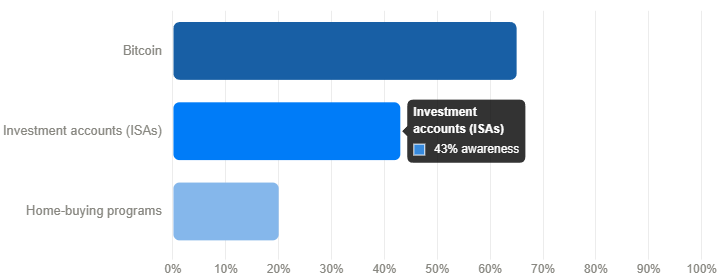
The data visualization tells the story bluntly. Bitcoin awareness among young Britons sits at 65%. ISA awareness — the savings vehicle that the UK financial establishment has spent billions promoting through government campaigns, bank advertising, and school curricula — lands 22 points lower at 43%. Home-buying programs, another cornerstone of traditional financial guidance for young adults, are known to just one in five.
This isn’t a marginal difference. This is a structural inversion of the financial awareness hierarchy that institutions have spent decades building. The altcoin ecosystem didn’t need government budgets or mandatory school modules to achieve this. It needed YouTube, Twitter, Reddit, and a technology that young people found genuinely more compelling than anything their bank had to offer.
“Crypto First, Traditional Finance Second” — a New Mental Model
The Coinbase researchers frame what’s emerging not as a trend but as an entirely new model of financial literacy: altcoin first, traditional finance second. That framing deserves unpacking, because it signals something more significant than just name recognition of Bitcoin.
For previous generations, the financial literacy journey followed a predictable sequence. You learned about savings accounts before you learned about stocks. You understood mortgages before you understood derivatives. The architecture of personal finance was scaffolded by institutions — banks, building societies, the government — who controlled both the products and the education around them.
That scaffolding is collapsing for the 16–25 cohort. Their first exposure to concepts like wallets, private keys, decentralized networks, yield, and asset volatility isn’t coming from a GCSE personal finance module or a Barclays leaflet. It’s coming from altcoin communities — Discord servers, crypto influencers, on-chain activity, and the visceral experience of actually buying, holding, and transacting with digital assets.
The result is a generation that understands block confirmations before they understand compound interest on a savings account. That knows what a seed phrase is before they’ve ever opened an ISA. The mental model is inverted — and once it’s inverted, it’s very hard to flip back.
Why This Is a Cultural Shift, Not Just a Statistic
Numbers like these tend to get dismissed by the financial establishment as a novelty — young people chasing volatile assets, eventually they’ll grow up and open a proper investment account. That dismissal misreads what’s actually happening.
Financial familiarity is the precursor to financial behavior. The products young people are aware of are the products they’ll use when they start earning, saving, and investing in meaningful amounts. If an entire generation enters adulthood with Bitcoin literacy and ISA ignorance, the assets they accumulate will reflect that. The platforms they trust will reflect that. The financial infrastructure they demand from their employers — for payroll, benefits, pensions — will eventually reflect that too.
The altcoin ecosystem has essentially executed a stealth financial education campaign across an entire generation, without a single government grant or school partnership. It happened because the technology was interesting, the communities were accessible, and — crucially — the stakes felt real. A teenager watching their first altcoin position move up or down 20% in a week learns more about risk, volatility, and portfolio psychology in a month than most traditional financial literacy curricula deliver in a full year.
That’s not an argument for replacing financial education with crypto speculation. But it is an argument that the altcoin ecosystem has cracked something that traditional finance education has consistently failed to do: make young people actually care.
The Government Education Gap — Two-Thirds of Young People Are Asking
Perhaps the most striking data point in the Coinbase study isn’t the awareness gap itself — it’s what young Britons want done about it. Approximately two-thirds of those surveyed said they’d like the government to educate them about innovative financial technologies and altcoins.
Read that carefully. This isn’t a population resisting financial education. It’s a population actively requesting it — on their terms, in the language of the technologies they’ve already adopted. They’re not asking to be taught what an ISA is. They’re asking for their government to meet them where they already are: in the altcoin space.
That’s a policy opening that very few governments have seriously acted on. The UK, like most Western economies, has treated altcoin literacy as something adjacent to mainstream financial education rather than central to it. The Coinbase data suggests that positioning is exactly backwards for this demographic. If financial regulators and educators want to remain relevant to the 16–25 cohort, the curriculum can’t relegate altcoins to a footnote on speculative assets. It has to start there.
What the Altcoin Industry Should Do With This
The altcoin ecosystem often argues about institutional adoption — which hedge fund is buying, which bank is launching a custody product, which sovereign wealth fund has allocated to Bitcoin. Those conversations matter. But this Coinbase finding points to a different and arguably more durable form of adoption: cultural embedding at the generational level.
A 19-year-old who knows what Bitcoin is before they know what an ISA is will be a 35-year-old who thinks about altcoin exposure before they think about their pension allocation. They’ll be a 45-year-old executive who asks their treasury team why the company is still settling intercompany transfers through SWIFT. They’ll be a 55-year-old policymaker who doesn’t need to be convinced that blockchain infrastructure is legitimate.
Generational familiarity compounds just like interest does. The altcoin ecosystem has already made the first deposit. The question now is whether it builds on that foundation with education, transparency, and genuinely useful products — or squanders the trust of the most crypto-literate generation in history on scams, pump-and-dumps, and complexity that serves insiders at the expense of newcomers.
The data says young Britons are ready to engage seriously with altcoins as a financial category. Whether the industry is ready to meet that seriousness is the more important question.
Leave a Reply