Mitsubishi Corporation, one of Japan’s most powerful conglomerates with tentacles across energy, food, chemicals, and financial services, has just signed up for JPMorgan Chase’s blockchain-based payment infrastructure. The platform is called Kinexys. And if you’ve been paying attention to where institutional blockchain adoption is actually heading — not the altcoin price ticker, but the underlying rails — this partnership is worth examining closely.
What Kinexys Actually Does
Strip away the press release language and Kinexys is doing something elegantly simple: it lets large, multi-division corporations move money between their own global entities almost instantaneously, on a permissioned blockchain, without the latency and friction that define traditional interbank transfers.
For a company like Mitsubishi Corporation — which operates across more than 90 countries through a sprawling network of subsidiaries and joint ventures — the implications are significant. Every day, cash is sitting idle in transit. Treasury teams are managing float across time zones. Intercompany settlements are waiting on correspondent banking chains that haven’t fundamentally changed in decades. Kinexys collapses that waiting time to near-zero.
This isn’t altcoin speculation. But it is blockchain — and it’s the version of blockchain that Fortune 500 boardrooms are actually willing to sign off on.
Five Years, $3 Trillion, and Accelerating
Kinexys launched in 2020. In the five years since, it has processed more than $3 trillion in transactions.
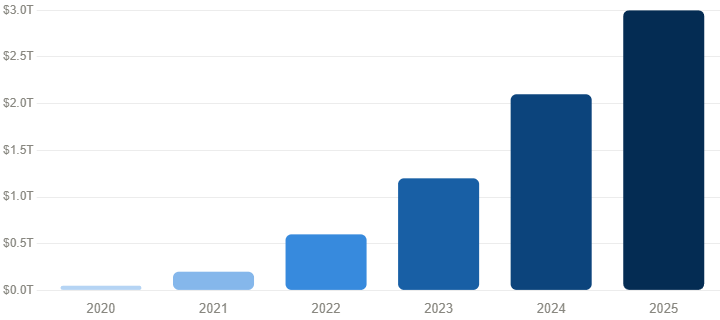
Let that number sit for a moment.The growth curve tells the story of institutional adoption better than any whitepaper could. The first years were slow — cautious pilots, internal stress tests, compliance reviews. Then the volume accelerated sharply as participants proved out the system and confidence grew. By the time Mitsubishi comes on board, Kinexys isn’t an experiment. It’s a functioning financial infrastructure layer with a multi-trillion-dollar track record.
That matters enormously. The biggest barrier to corporate blockchain adoption has never been the technology — it’s been the lack of proof that the technology works at scale, in production, with real money. JPMorgan has now provided exactly that proof.
Why This Move Makes Strategic Sense for Mitsubishi
Mitsubishi Corporation is not a startup hunting for edge. It’s a 100-year-old trading house that moves commodities, manages infrastructure investments, and operates businesses across virtually every sector of the global economy. When an organization like that makes an infrastructure decision, it’s not chasing a trend — it’s solving a real operational problem.
The core issue is treasury management at scale. When you operate dozens of subsidiaries across Asia, the Americas, Europe, and the Middle East, intercompany fund transfers become a significant operational burden. Traditional wire transfers can take one to three business days to settle. SWIFT messages involve correspondent banks who each take a slice. Currency conversion layers in additional cost and delay. For a company executing hundreds of intercompany transactions every month, the inefficiency compounds fast.
Kinexys removes the middle layers. Settlement happens on the blockchain in near real-time, without correspondent bank chains, without the float costs, and with complete auditability built into the transaction record by default. For a treasury team managing cash across 90+ countries, that’s not a minor upgrade — it’s a fundamental rearchitecting of how liquidity moves through the organization.
The Institutional Blockchain Thesis, Quietly Proven
The altcoin ecosystem has spent years making the case that blockchain infrastructure is superior to legacy financial plumbing. The argument was always logically sound. But institutional adoption lagged, held back by regulatory uncertainty, technical immaturity, and the reputational association with volatile speculative assets.
What JPMorgan built with Kinexys — and what Mitsubishi is now adopting — represents the other track of blockchain development: the one that runs in parallel with the public altcoin markets, largely invisible to retail investors, but deeply influential over where the technology ultimately lands. These are permissioned systems, built to enterprise compliance standards, operated by institutions with existing banking relationships and legal frameworks. They don’t make headlines on altcoin Twitter. But they’re steadily eating the lunch of correspondent banking.
The significance of the Mitsubishi deal isn’t just one company upgrading its treasury stack. It’s a signal about what the next decade of blockchain adoption looks like at the enterprise level. As more multinationals prove out the model, the pressure on traditional interbank infrastructure intensifies. Each new adoption makes the case for the next one easier to argue internally.
What the Altcoin Space Should Take From This
Here’s the connection that often gets missed: every time a company like Mitsubishi processes a transaction on blockchain infrastructure and finds it faster, cheaper, and more transparent than the traditional alternative, it validates the core premise that the entire altcoin ecosystem is built on. The argument isn’t “blockchain vs. altcoins” — it’s that institutional adoption of blockchain rails, even permissioned private ones, normalizes the underlying technology and gradually erodes the psychological resistance to anything blockchain-adjacent.
Treasury teams who’ve spent a year settling transactions on Kinexys are not the same skeptics they were before. They understand, viscerally, why decentralized settlement makes sense. That’s an audience that starts looking at public blockchain infrastructure — and the altcoin assets that live on it — with a very different set of assumptions.
JPMorgan didn’t build Kinexys to help Bitcoin’s price. But in legitimizing blockchain-based settlement at the highest levels of global commerce, it is doing something the altcoin ecosystem has struggled to do alone: making blockchain infrastructure boring, reliable, and safe enough for the most conservative institutions on the planet to depend on.
Mitsubishi just bet its treasury operations on it. That’s not a small vote of confidence.
Leave a Reply